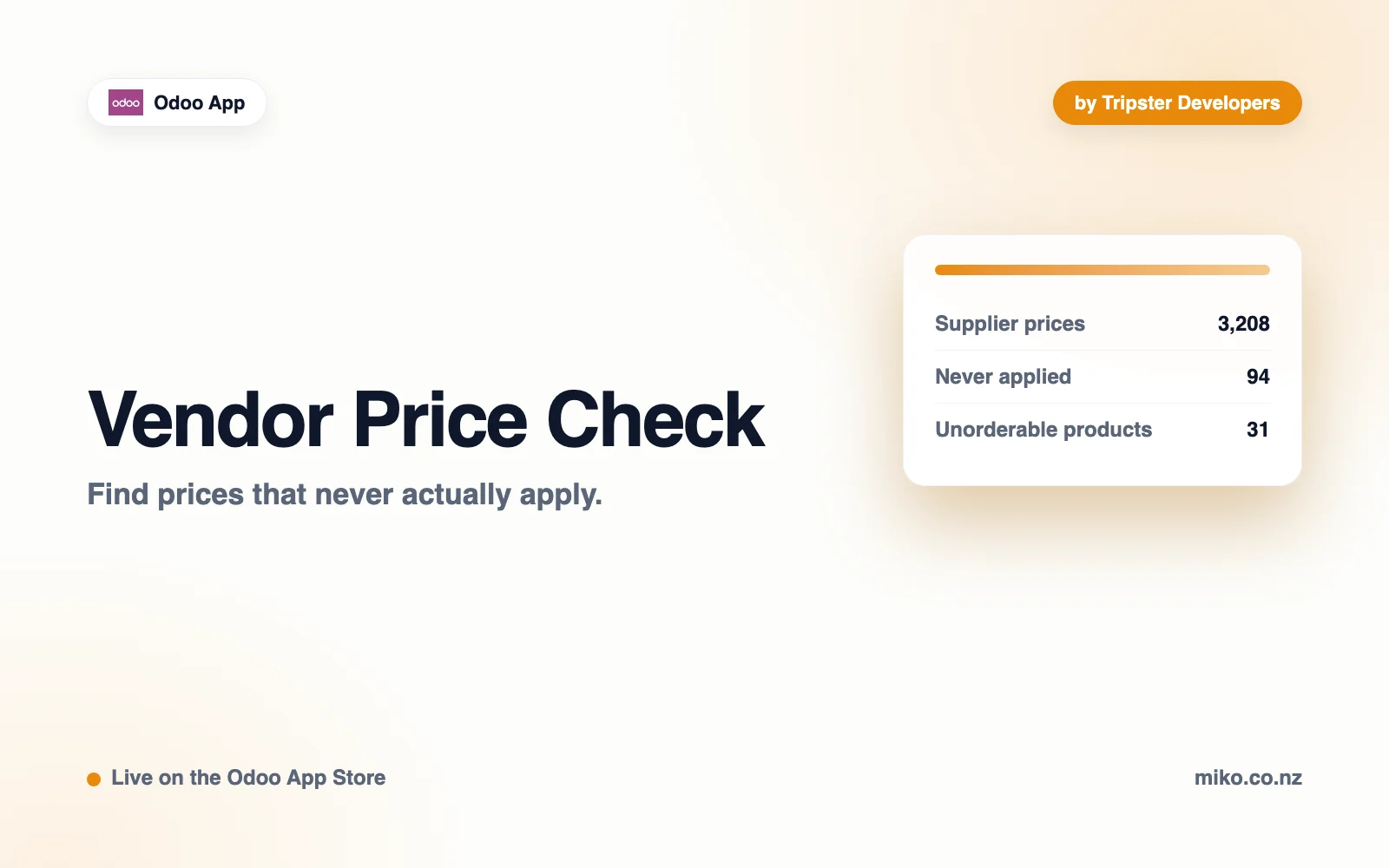
Live on the Odoo App Store
Find what you cannot reorder, before you need to. You discover a product has no supplier at the worst possible moment: when it has sold out and you are trying to reorder it.

Features
The same is true of a supplier price line that expired last quarter, or a minimum order quantity that means Odoo always picks another line first. This audits the buying side so those faults surface on a quiet day instead of an urgent one.
Which cannot be reordered. Only products marked as purchasable are judged: a product nobody buys needs no supplier.
Or can never be reached. Products where every supplier line has expired are called out on their own, and a line valid only in the future is marked as not started yet.
With the rest of your setup: a price line Odoo never selects because an earlier line for the same supplier and product, at a minimum quantity at least as low and valid across the same dates, always wins. Each one names the line that beats it.
A supplier line with no price can still be reached, it is simply priceless. Keeping the two apart points the buyer at the right problem.
Lines are ordered exactly as Odoo orders them, by sequence, then minimum quantity, then price, so a verdict matches what a purchase order would do.
Nothing on a supplier record is changed. Every fix is yours to make, and there is no external service involved.
How it works
Add the module to Odoo.sh or your own server and install it from the Apps menu. It needs only Purchase, and nothing runs on its own.
Products You Cannot Reorder and Supplier Price Lines show a status on every record. Recheck Supply and Recheck Supplier Lines refresh them on demand.
Start with the products you cannot reorder, the ones that will stop you when you need them, then clear the lines Odoo never uses: they are noise on every supplier record.
Technical Edge
Purchasing data is only exercised when you purchase. A product with no supplier sits quietly in the catalog for as long as it is in stock, and announces itself the first time it sells out. An expired supplier price line behaves the same way: everything looks configured until the moment it has to produce a price.
Auditing the buying side on a quiet day converts an urgent problem into a scheduled one.
Checked in the module code and the live Odoo App Store listing, September 2026
Pricing
Sold on the Odoo App Store under the Odoo Proprietary License (OPL-1). Each Odoo version is sold separately.
USD 29
One-time purchase · OPL-1 · Odoo 14.0 to 19.0
On quote
Scoped with you before any work starts
Odoo stores app prices in euros and shows a converted figure at checkout: US$28.89 on 25 September 2026.
Built For
Anyone reordering from more than a handful of suppliers, and anyone whose supplier agreements have dated price lines. Both accumulate faults that no screen in Odoo puts in front of you.
FAQ
Products with no supplier at all, products where every supplier line has expired, supplier lines with no price, and supplier price lines that can never be reached because another line for the same supplier and product, at a minimum quantity at least as low, always wins.
On a quiet day. Purchasing data is only exercised when you purchase, so a product with no supplier announces itself when it has sold out and you need it. Auditing early converts an urgent problem into a scheduled one.
No. It audits and reports so you can fix them deliberately.
Odoo 14, 15, 16, 17, 18 and 19. Every listed Odoo version is certified on each release by installing the module into a real Odoo image of that series and running the full test suite. A version is only listed once it passes.
Odoo Online cannot run third-party modules that contain Python, which is Odoo's rule rather than ours. Odoo.sh and self-hosted installs are both fine.
Email hello@tripsterdevelopers.com with your Odoo version, the module version and what you did. Tell us the product or supplier line and the status it shows, which answers most questions immediately.
Yes. Odoo 14, 15, 16, 17, 18 or 19, Community or Enterprise. The same build installs on either edition.
Buy and download the module from its Odoo Apps Store page, place the folder in your addons path, restart Odoo, then update the apps list and install it from the Apps menu. Odoo.sh users add it to the repository branch instead.
Each listed Odoo version has its own build, and the Odoo Apps Store sells each version separately. When you move to a new major version, install the build for that version; the statuses are recalculated by the new build.
Inside your own Odoo instance. The module runs on your server and does its arithmetic on data already in your database, with no external service. We do not host your records and we do not receive a copy of them.
Yes. Odoo modules are distributed as readable Python and XML, so your own developer can review exactly what runs and extend it under the license the module ships with (OPL-1).
Your Odoo version, the module version from the Apps screen, and the record and status that look wrong. Those three together are usually enough to answer in one reply rather than four.
Yes, at the same support address. Say what you are trying to achieve rather than the field you want added; it is often already possible, and when it is not, the underlying goal is what shapes the change.
Not as a separate page. The current version for each Odoo series is shown on the module's Odoo Apps Store page and on the Apps screen in your own database; ask the support address what changed between two versions and you will get a straight answer.
Tripster Developers, a Shopify Partner and Odoo module publisher based in Auckland, New Zealand. The same team writes the code and answers the support mail.
Miko Apps
Live on the Odoo App Store, published by Tripster Developers · USD 29 one-time per Odoo version
Miko for Odoo
Published and maintained by Tripster Developers on the Odoo App Store. See all Odoo apps.
Not on Shopify yet?
Set up your store in minutes and try it with your own products. Loyalty, wholesale pricing, AI descriptions and the rest of the Miko apps install in one click once your store is live.